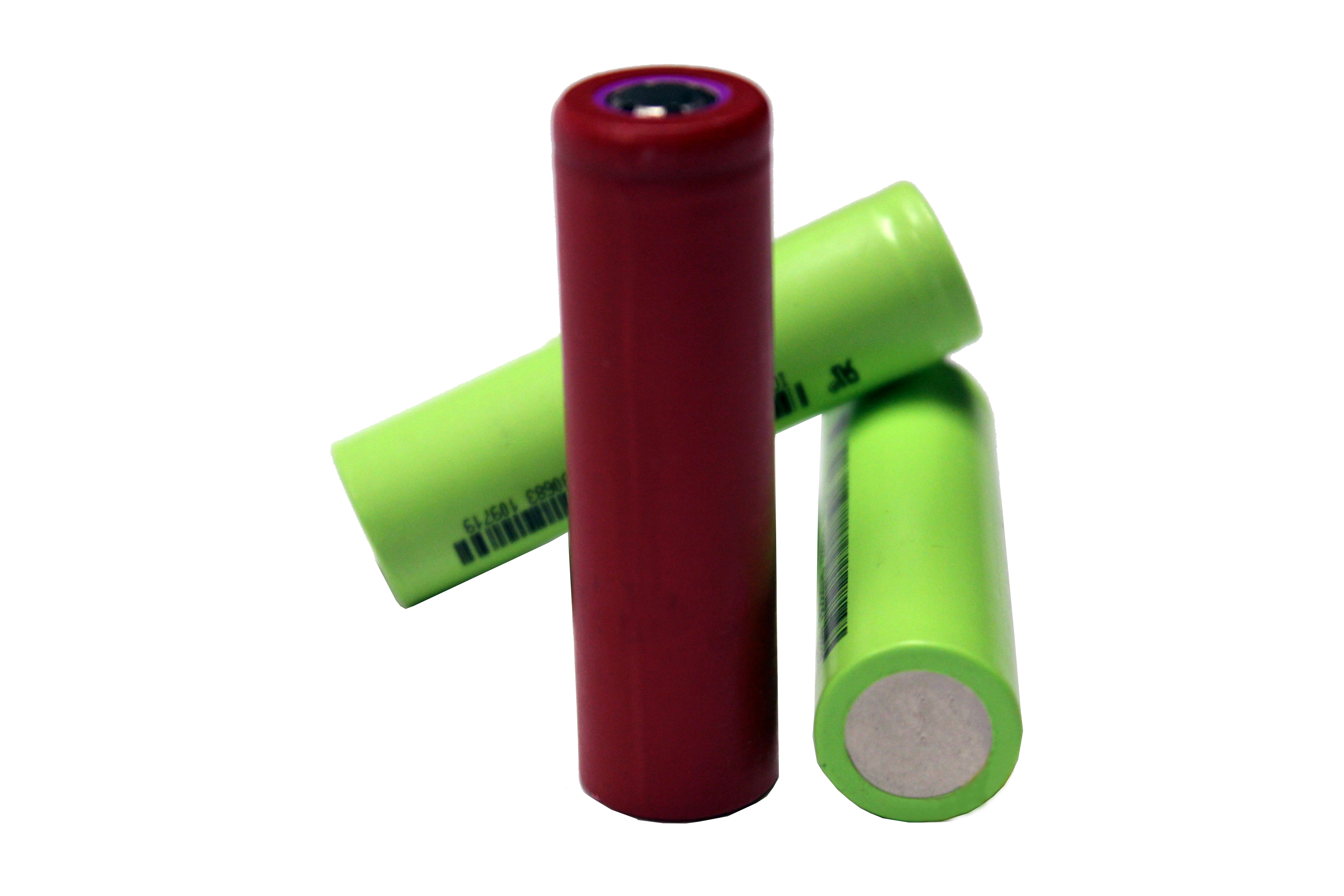
Lithium Ion
Lithium Ion (Li-Ion) cells have a negative electrode (anode) made from lithium compounds. Lithium is a highly reactive material and is much lighter than the hydrogen-absorbing metal alloy of the NiMH negative electrode. This leads to higher gravimetric energy densities for the Li-Ion cell. Cells can be stored for 12 months without requiring maintenance*. The expected cycle life of a Li-Ion in an application is about 500+ full charge and discharge cycles.
- Standard Cell Sizes Available
- Standard and Custom PCM
- Custom Cell Sizes Available
- Cylindrical Form Factor
*Dependent upon storage conditions
| Typical Performance Characteristics of Lithium Ion Batteries | |
| Operational Battery Voltage | 4.2 to 2.7 Volts |
| Specific Energy | 100 to 158 Wh/Kg |
| Energy Density | 185 to 220 Wh/L |
| Power Density | 245 to 430 W/Kg |
| Continuous Rate Capability | Typical: 1C High Rate: 5C |
| Pulse Rate Capability | Up to 15C |
| Cycle Life | Typically 500 |
| Calendar Life | 3 – 5 years |
| Self Discharge Rate | 0.3% / month |
| Operable Temperature Range | -20C to 60C |
| Memory Effect | None |
Note: Characteristics can change according to improvements in chemistry or special niche requirements.
Typical Application
- Medical tools
- Industrial applications
- Consumer electronics
- Portable devices
- Military applications
- Power banks